Marine Catfish In Singapore Waters
- marinecatfishresea
- Jan 13
- 4 min read

Updated: Jan 16
Marine catfish have long been a feature of Singapore's aquatic ecosystem, yet they remain one of the least understood groups of fishes in the region. While familiar to many recreational and artisanal fishing communities in Singapore, their ecological role, species diversity, population and health status in Singapore is poorly documented.
Historical records show that marine catfish were already reconised in Singapore waters during the colonial era as early as 1850 by Cantor. Early naturalists documented their presence in local waters and warkets, often recording them under braod family names rather than individuals species. This lack of detailed identification has continued to present times, making it difficult to know extacly how many species are presnet today, and in what numbers.
Singapore's position between the South China Sea and the Adaman Sea palces it in a region with high diversity of marine catfish species. However, Singapore's highly urbanised coastline, constant land reclamation and absence of natural freshwater rivers feeding into estuaries mean that local diversity is likely lower than neighbouring waters and counties. This is espeiaclly so in semi-closed areas such as the Johor Strait. Still, marine catfish are often encountered by fishermen but are still commonly overlooked or misidentified.
Despite their continued presence, marine catfish are rarely recorded in fisheries statistics. In many cases, they are grouped under vague labels such as “unidentified marine fishes” or lumped together as a single generic group. This is partly because Singapore no longer has a commercial fishing industry. Today, most marine catfish encoutered are bycatch or caught by artisanal and recreational fishers, meaning catch data is sparse and inconsistent.
What makes this especially important is that some marine catfish species recorded in Singapore in the past have not been observed in recent years. Whether this reflects real population declines, changes in habitat, or simply a lack of monitoring is currently unknown. This knowledge gap demonstrates the need for better data on which species are present, where they occur, and how they move through Singapore’s coastal waters.
Why Tag Marine Catfish?
Tagging marine catfish is a powerful tool to help learn about these fish. By tagging individual fish and tracking when and where they are recaptured, researchers can learn about:
Movement patterns – how marine catfish use Singapore’s coastal habitats
Population structure – whether fish belong to local or wider regional populations
Habitat use – the importance of mangroves, estuaries, and open coastal waters
Survival and growth – how these fish respond to urbanised marine environments
This information is essential for understanding the true status of marine catfish in Singapore and for ensuring that they remain a healthy part of our coastal ecosystems.
Tagging Methods
Tagging marine catfish can be carried out using several approaches, each suited to different research questions, budgets, and study scales. In Singapore, tagging methods must also account for shallow coastal waters, high fishing pressure, and urbanised habitats.

1. Conventional (External) Tagging
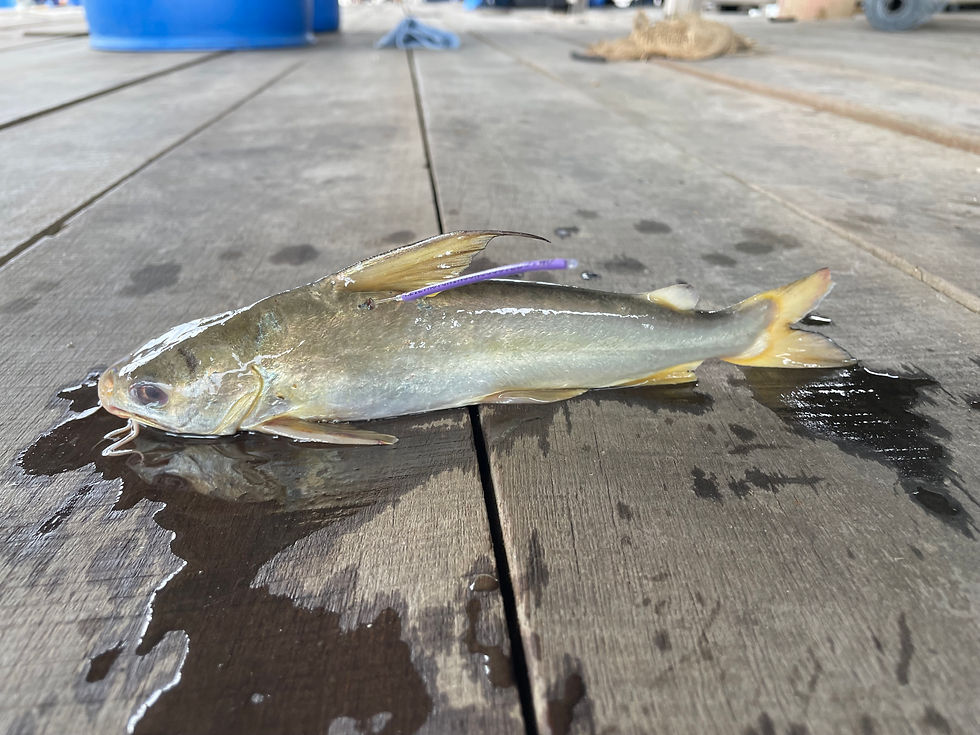
Conventional tagging is the most widely used and practical method for marine catfish studies. This involves attaching a small, numbered physical tag—usually near the dorsal fin or at the base of the fin—before releasing the fish.
These tags are designed to be durable and resistant to marine conditions. Data is collected when tagged fish are recaptured and reported by fishers. This method is especially effective for studying:
Growth rates
Survival
Broad-scale movement
Population size and structure
Conventional tagging is low-cost, minimally invasive, and well suited for citizen science and recreational fisher participation. This is the perffered approach of the Singapore Marine Catfish Research Project.
2. Acoustic Tagging
Acoustic tagging most commonly involves the surgical implantation of a small transmitter into the fish. Alternative approaches include insertion into the body cavity or subcutaneous tissue, as well as external attachment using wires or applicators, depending on fish size, behaviour, and research objectives. The tag emits sound signals that are detected by underwater receivers placed in specific locations or via following the signal in a boat.
This method allows researchers to track fish movements within a defined area over time and is particularly useful for understanding:
Habitat use
Residency and site fidelity
Movement patterns around fish farms, mangroves, and coastal structures
However, acoustic tagging is more expensive and logistically demanding, and its coverage is limited to areas with receiver arrays.
3. Satellite and Archival Tagging (Limited Use)
True GPS tracking is generally not feasible for most marine catfish due to their size, depth use, and coastal habits. As marine catfish are often regarded as relatively common species compared to charismatic megafauna such as sharks and whales, the use of satellite tags is generally considered disproportionate to the research benefits. While pop-up satellite archival tags can record environmental data and transmit it upon release in some marine species, they are rarely suitable for ariids due to constraints related to body size, behaviour, and habitat use. As a result, satellite-based tagging currently plays no role in marine catfish research in Singapore.
Data Collection and Analysis
Once marine catfish are tagged and released, data collected from recaptures or detection systems are analysed to understand their ecology and behaviour. Researchers look for patterns in:
Movement and space use
Habitat preferences
Seasonal or site-specific activity
This information is essential for several key outcomes:
Population assessment: Understanding population size, recruitment and mortality helps determine whether local populations are stable, declining, or recovering.
Habitat conservation: Identifying important habitats allows for targeted protection of areas such as mangroves, estuaries, and nearshore zones.
Fisheries management: Tagging data supports evidence-based decision-making to ensure marine catfish populations remain sustainable.
Challenges in Tagging Marine Catfish
While tagging provides valuable insights, several challenges remain:
Tag loss: Tags may be shed over time or damaged, leading to incomplete data.
Behavioural effects: Handling and tagging can temporarily affect fish behaviour, particularly immediately after release.
Environmental variability: Changes in water quality, temperature, and habitat structure can influence fish movement, making patterns harder to interpret.
Despite these challenges, tagging remains one of the most effective tools for studying marine catfish in real-world conditions.
Conclusion
Marine catfish are a long-standing yet under-studied part of Singapore’s coastal ecosystems. Tagging studies offer a practical way to uncover where these fish live, how they move, and how they interact with increasingly urbanised marine environments.
By combining scientific research with public participation—especially through conventional tag-and-recapture programs—we can begin to close long-standing knowledge gaps and ensure that marine catfish continue to play their role in Singapore’s coastal biodiversity.
Every tagged fish, and every reported catch, helps build a clearer picture of life beneath Singapore’s waters.
Comments